Research data is one of the most valuable outputs of research. Sharing research data openly allows others to verify findings, build on existing research, and accelerate scientific discovery. However, making data public does not automatically make it easy to find or reuse. This is where the FAIR principles come in.
What is Open Data?
Definition
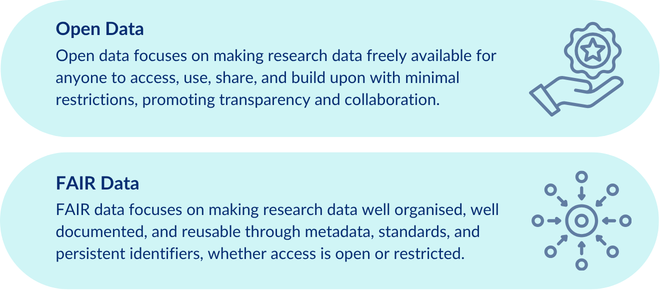
Open data is research data that is freely accessible, reusable, and shareable, typically with proper citation. In research, this usually involves making datasets available in a trusted repository for others to access and reuse.
What It Includes
Open data can include experimental results, survey data, images, software code, models, and other research outputs. By making these outputs available, other researchers can verify findings, perform new analyses, and build on prior research without repeating data collection.
Requirements
For data to be truly open, it should be openly licensed and provided in formats that are easy to access and reuse. However, not all research data can be shared openly. Restricted access may be required for personal, sensitive, or confidential information.
What Are the FAIR Principles?
The FAIR principles describe how research data should be managed to be easily found, accessed, combined, and reused. FAIR data does not have to be fully open; some datasets may be restricted for ethical, legal, or privacy considerations but still be FAIR.
FAIR focuses on how data is managed rather than whether it is publicly available. Even restricted datasets can be FAIR if researchers can discover them, understand the access conditions, and interpret the information they contain.
What Does FAIR Stand For?
Each letter in FAIR represents a key principle for effective research data management.
Findable
Data has clear metadata and persistent identifiers, making it easy to discover and locate.
Interoperable
Data follows common formats and standards, allowing integration with other datasets and systems.
Accessible
Data can be retrieved using standard methods with clear and transparent access conditions.
Reusable
Data is clearly documented, well licensed, and described so that others can confidently reuse it.
Why FAIR Principles Matter
Open Data increases access to research, while the FAIR principles ensure that research data remains discoverable, understandable, and reusable over time. Without metadata, documentation, standard formats, and persistent identifiers, data can be difficult to find, interpret, and reuse effectively.
Supports Data Reuse
The FAIR principles make research data easier to find, access, integrate, and reuse through metadata, standard formats, persistent identifiers, and clear documentation.
Increases Research Value
Applying the FAIR principles increases the long-term value of research data while supporting transparency, collaboration, reproducibility, and future research.
Open Data vs. FAIR Data
Although they are closely related, open data and FAIR data are not the same.
The aim of Open Science is to make data as open as possible and as closed as necessary, while following FAIR principles.
Many research projects in practice aim to achieve both. Open data makes data more accessible, and FAIR principles contribute to making data useful, understandable, and reusable over time.
Benefits of Open and FAIR Data
Open and FAIR data can:
Improve transparency and reproducibility by allowing others to verify findings.
Increase the visibility and reuse of research outputs.
Reduce duplicated effort by enabling researchers to build on existing data.
Encourage collaboration across institutions and disciplines.
Support compliance with funder and institutional data-sharing requirements.
Support long-term preservation through trusted repositories.
Challenges and Considerations
Sharing research data is not always straightforward. Common challenges include:
Privacy and Confidentiality
Personal or sensitive data may require restricted access or anonymisation.
Time and Resources
Preparing data for sharing requires good documentation, metadata, and organisation.
Licensing and Ownership
Researchers must ensure they have permission to share data and apply appropriate licences.
Disciplinary Differences
Data standards vary across research disciplines, as well as data repositories and data sharing practices.
Conclusion
Open data and the FAIR principles are complementary and not interchangeable. Open data contributes to research being more accessible and FAIR principles contribute to the research being discoverable, understandable, and re-usable over time.Together, they maximize the value of research and support the wider goals of Open Science.
Solutions designed to tackle these challenges include data management services, trusted repositories, researcher training, and clear policies. Early planning for data sharing makes it easier to meet both Open Data and FAIR principles.
Resources
For resources on Open and FAIR Data, please check out the following: